Cedarfall lore · Faction
The Torvayne Compact
Many halls, one road.
a league of frontier towns in the Greenmarch. Timber forts, scouts, tally-boards and arguments held in public.
Origin and history
Nobody planned the Compact. Eleven frontier towns wanted to stay alive, and somebody had to keep the tally of who owed what. It turned into a government by accident. Every town tells the founding story differently and the Compact counts that as a feature, mostly.
- 180 BFSettlers from the Sorrel mouth raise a timber palisade at Torvayne Ford to trade for copper from the eastern hills. It pays the Crown's tolls late and ignores the Wardens when it can.
- 97 BFCopperwick grows up around its first smelter. Inside a generation it is the richest town on the frontier and the smokiest.
- 0The Felling. The mist reaches the eastern towns first. They have no walls and no warning.
- 9 AFThe Closing of the Gates. The Crown's keeps pull back. Torvayne Ford's reeve, Hesper Alder, sends riders to every neighbor with one line: "Shut your doors and open the road." Half the riders get lost. The line still arrives.
- 12 AFThe First Table meets at Torvayne Ford. Eleven towns send one delegate each. They agree on one rule, that no town is turned away and no town is forced, and then argue about the second rule for six days.
- 31 AFThe Crown's Levy of Grain rolls east in frontier wagons. The Compact answers with the Long Hunger Relief, sharing what grain exists among every town, including those the Crown had written off. It costs the Table two winters of debt.
- 58 AFThe Torvayne Accord is signed. It sets a common defense, a shared scout service and a standing fund. It sets nothing else on purpose.
- 74 AFAt the Thornfield Parley, Speaker Orlen Brask puts the Table's seal next to the Crown's under the Lantern Truce. His boots are ruined and he mentions it.
- 112 AFThe Compact counts twenty-three member towns. Wayscouts walk the edge of the blight every night, and have a rota for it.
Government and culture
The Compact is run by the Table, a standing council with one seat per member town. A Speaker chairs it and has no power beyond the gavel. Decisions get made in each town's moot hall first, then a delegate carries them to the Table and may not go beyond the town's instructions. Agreements are scored in notches on tally-boards, so a miller can read what the magistrate promised.
Torvayne manners run to hospitality and blunt talk. A stranger at the door gets a bowl of broth first and questions after. Houses are dark timber on low stone footings, with steep thatch or cedar-shingle roofs and copper on the hinges. Every house has a hanging lantern and a name, and the names are mostly jokes. Markets are loud, there is a fiddle somewhere, and arguments happen in the open where people can take sides.
The Compact's weakness is speed. A decision can take three moots and some never get made. They also distrust anyone who gives orders for too long, because they have been burned.
Values and goals
- Independence. A town decides for itself, inside the Accord.
- Open roads. Nobody is shut out and no road gets closed.
- Work over paper. What a person can do counts for more than what a seal says they are.
- Fair counting. Whatever is shared gets counted, and the count is posted on the board.
What they want from the realm: free, connected towns, with the Crown's help if it comes as a partner. What they want from the Hollow Host: survival first, profit second. The Compact clears lairs to keep the roads open, salvages whatever it can carry, and waits for a day the blight can be pushed back for good. A few scouts think the Host can be understood. Most think it can only be outlasted.
How they see the Velmoran Crown
In public the Compact calls the Crown "the Walled," half respect and half joke. Torvaynes admire the discipline and the roads. They haven't forgiven the Closing of the Gates and retell it at least once a season, usually when a Velmoran is in the room. A Torvayne will say the Crown can't be trusted with a promise that isn't written down, and won't write down a promise it plans to break. There are exceptions. Several Compact captains trained at the Citadel and speak well of the food.
Iconic places
- Torvayne Ford. The first town, with a timber moot hall built across the river on piles. It floods every other spring and the moot meets on the roof.
- Copperwick. The smelter city. Green copper roofs gone black with smoke, and the Table's treasury under the foundry floor.
- The Oakhallow Moot. A ring of living oaks where the Table meets in summer. Each delegate grafts a cutting from their home oak into the ring. Two have died, and the towns concerned don't discuss it.
- Thistledown Palisade. The eastern-most fort, a ring of cedar logs on a hill. It has been rebuilt six times.
- The Sorrel Way. The Compact's own road, narrower and crookeder than the Ashlar Road, with a Waystead every half-day's walk and a lantern in each.
Notable figures
- Speaker Orlen Brask. Chairs the Table. A broad, patient former mill foreman who says "let's count it" so often that delegates now say it first to get ahead of him.
- Tamsin Harrowell, "Longstride." Captain of the Wayscouts. Has walked the whole edge of the blight twice and the Reach once, and will tell you about the Reach.
- Yarrow Dunmore. Master of the Copperwick Foundries. Argues with everyone and funds half the Compact's forts, and keeps the receipts.
- Cade Alder. Ferryman of Torvayne Ford and descendant of Hesper Alder. Keeps the original tally-board of the First Table behind his bunk.
- Wren Ostler. A young delegate from Thistledown who wants a standing army, which the Compact does not want, and who isn't wrong about the arrows.
Military style and units
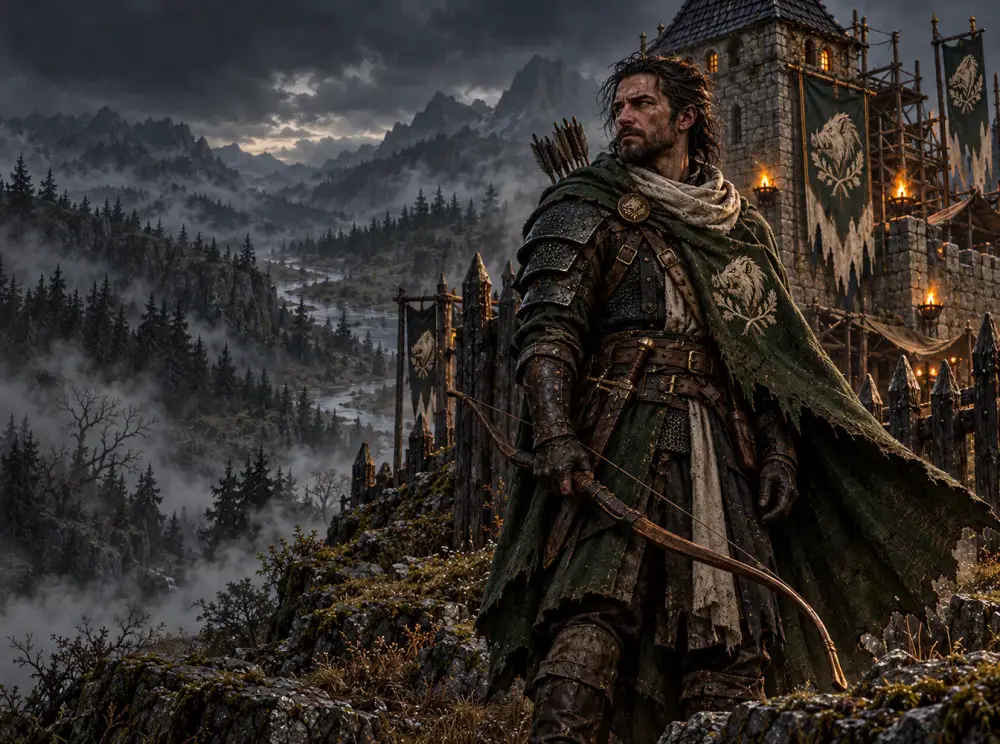
The Compact fights from cover and chosen ground. Each town raises its own company and drills it on its own terrain. Armor is quilted jerkin, studded leather and copper-fitted helms under forest-green cloaks. Tactics run to ambush, timber lines and a quick fall back to a palisade. They dislike fighting anywhere they didn't pick.
- Hearthguard (militia and infantry). Town militia with round shields, axes and spears. Look: green cloaks, copper bosses, cream-painted shield rims.
- Wayscouts (archers). Hunters and trackers with short horn bows. Look: layered leaf-green hoods, copper arrowheads, cream fletching.
Outposts in the Compact's story
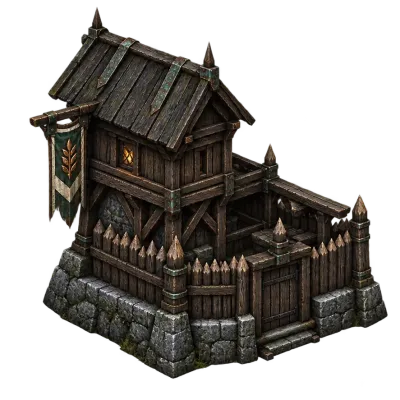
The Compact calls them Waysteads, an old ferry-trade word for a place to rest and mend. Each Waystead is a small copy of the Compact: a founder names it, hangs a lantern, raises a palisade and offers a bowl and a bunk to anyone on the road. The Table's tally-board records it, but the founder runs it and answers for it.
A Waystead is a small timber palisade with a shingle roof and a green banner. It gathers coin and a trickle of timber, stone and food, and takes a garrison of Hearthguard and Wayscouts. A full one is called warm. A Waystead that keeps its lantern lit for a year earns a copper plate on the gate, and founders fuss over the plate more than the walls.
Every Waystead hangs a lantern and carries its founder's name on a gate-board. Travelers of either banner can knock. Whether they get in is the founder's call.
Branding and identity
Colours: Forest green, cream, and copper.
| Colour | Hex | Use |
|---|---|---|
| Forest green | #2F5D3A | Primary. Banners, shield fields, heading bands. |
| Copper | #B4683A | Trim, rivets and accents. Use on cream or dark, never on green. |
| Cream | #F1E4C8 | Text on green, banner devices, boar and oak silhouettes. |
| Timber brown | #8D7855 | Palisade and wall tone (client wall tone). |
| Cedar shingle | #6E4630 | Roofs and secondary fills (client roof tone). |
| Deep moss | #12150F | Client UI background in the Torvayne theme. |
| Copper UI accent | #A87948 | Client UI accent, borders and focus rings. |
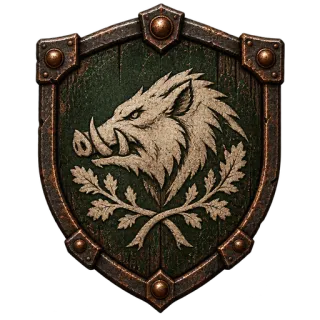
Sigil. A cream boar's head over two crossed oak sprigs, on a forest green shield of dark planks bound with copper-riveted iron. The boar is the frontier's stubbornness. The oak is for the towns that grew from one acorn each. Motto (English): Many halls, one road. Motto (Torvaynish): Orrun hal, ennet vey. It means "many halls, one way" and is said OR-run hahl, EN-net vay.
Typography and tone. Warm, plain, direct. Serif headings with a looser, handmade feel. Short sentences and contractions are fine. The Compact talks like a neighbor: "Come in, sit down," "let's count it," "the road's open." Humor runs dry and a bit rueful. No pomp, no commands.
Banner and crest usage. Put the crest on a dark or cream ground with clear space of at least a quarter of its width. Keep it upright and in its own colors. Banners are rectangles or pennants hung from a timber crossbar with a copper finial, the boar and oak centered. They may look hand-sewn and a little uneven.
Do
- Wear everything in: dark timber, aged copper, rough cloth.
- Set cream text on green, at WCAG AA contrast or better.
- Draw asymmetry, lanterns, thatch, shingle, palisades and winding paths.
- Use copper like firelight on a dark wall, as a warm accent.
Don't
- Skip neon or lime green and shiny new orange.
- Skip copper text on forest green. The contrast is too low.
- Keep Velmoran navy and brass out of Torvayne art unless you are showing the rival's banner.
- Don't draw the Compact as chaotic. It is slow and loud, and it counts everything.
Read on
The Velmoran Crown · World overview and glossary · All factions