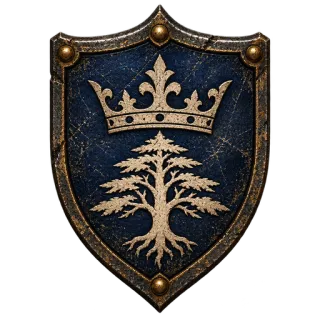
The Velmoran Crown
Stand, and the stone stands.
the old royal power of the Greenmarch. Grey ashlar keeps, drilled ranks and a very long memory for debts.
Deep navy, ivory, and tarnished brass.
Read the Velmoran loreCedarfall lore
A river country, a creeping blight, a restless dead and two banners that share one fragile truce.
The Greenmarch is a long river country. Cedar forest covers most of it, with wet meadows in the low ground and grey upland pasture where the soil gives out. The Highmere ridge closes the north. The Ashen Reach closes the south-east, and nothing green has grown there in living memory. The Sorrel River runs down the middle, slow and brown, and floods in Sap whether anyone is ready or not.
People here count years from one night. Dates run Before the Felling (BF) and After the Felling (AF), and the current year is 112 AF. Cedarfall is what most folk call the age since, and it is also the name painted on the first ferry-house sign downriver, which confuses visitors.
The Felling happened at Harrowmere. The Great Cedar there was older than any kingdom's records, and a Velmoran surveyor once spent a whole summer trying to count its rings before giving up. It came down in a dead calm with no axe near it. The morning after, a cold mist sat on the Reach and the people who had been buried there were up and walking. The grave-diggers' guild has never forgiven the Crown for what that did to the trade.

The mist turned into the blight. It greys the grass, sours wells within a season and makes dogs refuse to cross certain fields. It hasn't spread in forty years. It hasn't pulled back either. The edge of it is a bad place to farm and a good place to find abandoned farms, with the doors still on.
What lives inside is called the Hollow Host. Ghouls that have the look of the starved. Wraiths that trail smoke. Banshees, whose cries carry a full day's walk on a still night. Other things nobody has named, since naming them means going close. They are bone-pale with a sickly teal light behind the eyes. Scholars on both sides disagree about nearly everything concerning them, but a few points are settled.
Neither the Crown nor the Compact claims to have solved the Host. Each claims to be better at living next to it, and each keeps tallies to prove it.
Before the Felling there was one power in the Greenmarch, the Velmoran Crown, which held the valley for two centuries with stone roads and sworn lords. After the Felling it pulled behind its walls to stay alive. The frontier towns it left outside the walls stayed alive a different way, by joining up. That became the Torvayne Compact.
For sixty-odd years they barely spoke. Then in 74 AF, in a wet field at Thornfield, both sides signed the Lantern Truce. Nobody liked it. The terms were short. The open frontier belongs to whoever can hold it. Anyone who turns up, from a younger son of a minor lord to a ferry-hand with a debt, may swear to either banner and found a holding. The two banners leave each other's settlements alone, and both are free to raid the Host.
That is the arrangement you step into. Two banners, one enemy that never quite attacks, and a truce held together by suspicion and a shared interest in the roads staying open.
Every claimant swears to one banner. The choice shapes your story, your heraldry and the look of your holdings. It never shapes your strength.
Stand, and the stone stands.
the old royal power of the Greenmarch. Grey ashlar keeps, drilled ranks and a very long memory for debts.
Deep navy, ivory, and tarnished brass.
Read the Velmoran loreMany halls, one road.
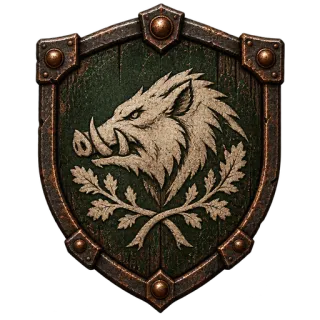
a league of frontier towns in the Greenmarch. Timber forts, scouts, tally-boards and arguments held in public.
Forest green, cream, and copper.
Read the Torvayne loreAn outpost is a holding a player founds on open ground, away from the home keep. It gathers coin and other resources over time, and you can garrison it with militia and archers. Under the Lantern Truce, building one is how a claimant makes the frontier theirs. You name it, hang your faction's banner on it, and your name shows beside it on the map.
The Crown calls an outpost a Warden's Post and treats it as a bit of the Roll pushed into the wilds. The Compact calls it a Waystead and treats it as a new house on a shared road. The rules are the same for both. Each faction's page says how the story differs.
Years run from the Felling. Seasons follow the cedar: Budding, Sap, Needlefall and Hollowtide. Hollowtide is deep winter, when the mist is heaviest and everyone tells the old stories whether they want to or not. The Crown records dates in the Roll in ink. The Compact scores them on tally-boards in moot halls. They agree on the year, at least.